Tuesday, January 27, 2009

How Does That Go?

Did you ever have the melody of a song in your head, and have a heck of a time pairing it with a song title? Or what about just one song lyric from the chorus?

Although it is not yet possible to whistle a tune to a website and have it match the melody to a song title, it is possible to research song titles by lyrics.

Here are some strategies to find your song:

1. Google it. Put quotation marks around the song lyric in question, and do your search. Websites that contain that particular song lyric (sometimes including audio) might pop up. If you know who wrote the song or performed the song, you can also Google the person's name and the song lyric in quotation marks, OR Google the person's name and "discography". (Many online discographies include audio clips of the songs featured on each recording.)

2. Google the term "song lyrics", and find websites that contain databases of lyrics from thousands of songs.

Monday, January 26, 2009

Spice Research

One of the biggest research challenges that I face is tracing the history of spice usage and spice trade in northern Europe. There are many reasons why this work is so difficult:

1. Throughout most of history, the people who knew the most about spices were often illiterate. They were either cooks or traditional healers, and their employers did not always think that their work was important enough to record.

2. Spices were incredibly expensive throughout most of history, only used by the wealthy. Many merchants often kept their account ledgers and inventories in code, so that no one except that merchant family would know for sure what type of spices they handled, or how much money they had earned from those spices.

3. Biologically accurate plant illustrations did not appear in books until the invention of the Gutenberg Press in the mid-15th century. The average northern European would not be able to identify most plants from a book published in the Dark Ages or Middle Ages. Here are some examples of spice drawings from that time:



This is an Arabic translation of a classic Greek herbiary. Not only do all of the plants look like dandelions, but there are no standard words to describe leaves, stems, roots, or other parts of the plant. It was very easy to mix up plants, especially foreign exotic ones. This was a big problem for doctors, as plants, herbs, and spices were used as medicine. People had to rely solely on the text for whatever factual information they could find.

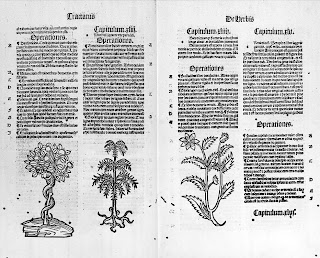


Here is another one, from a German health encyclopedia. As late as 1491, reference books still contained unidentifiable plant drawings. Some of the plants are even imaginary. (The drawing to the left is the "Tree of Life", if you ever run into it...complete with serpent.)

4. The Church has hidden away some of the best material on spices. Contrary to popular belief, many priests and monks of early Christian Europe were not far removed from their pagan roots, and they still indulged in the intake of spices as aphrodisiacs. Meanwhile, wars were fought over the consumption of gingerbread and highly spiced fermented beverages such as glogg and wassail.

Even the modern history of spice is highly secretive. In Cardamom: The Genus Elettaria by Indian botanists P.N. Ravindran and K.J. Madhusoodanan, I am left hanging by this fact:

"Cardamom was introduced in Guatemala only in early 1920s from Sri Lanka or India with the help of a New York broker and was planted in the vicinity of Coban in the Department of Alta Verapaz" (Ravindran, 2002).

Who was this spice broker? Must I travel to Coban to find his name? I cannot trace the name of this broker anywhere else in the literature, but I do not doubt the information, as India is the home of cardamom, and southern India is home to many cardamom research institutes.

5. There is no "paper trail" of previous research done on particular spices. Internet research on spices is the worst, as very few "facts" are cited, and some end up not being true at all if you do the grunt work of hitting the books.

Friday, January 23, 2009

Obama's People

Obama's People is a photo exhibition of Barack Obama's top 52 advisers. This is probably the most diverse cabinet of presidential advisers in the history of the United States, and it made me ask many questions. My IM 204 class and I did some fact-finding on a few of the advisers:

James E. Clyburn: Majority Whip: The first South Carolinian and second African-American to hold the position of Majority Whip. Clyburn was a major figure in the Civil Rights Movement, and served as Congressman of South Carolina. His career in politics started at 12 years old, when he was elected president of his NAACP youth chapter. In 2005, Nancy Pelosi invited him to serve on the Democrat's Faith Working Group.

Rahm Emanuel:
Chief of Staff: Emanuel's Jewish roots and tough, mercurial personality precede him. Now that he is in Obama's Cabinet, he is doing his best to keep a calm demeanor although he will always remain a challenger and instigator. This is the main reason why Obama has selected Emanuel for this position; to have an unwavering Devil's Advocate when discussing important issues, and to serve as the unrelenting front guard for items not up for discussion.

John Favreau: 27 years old: Speechwriting Director: aka "The President's mind reader." Though the young Favreau may be a highly perceptive wordsmith, he did not realize that a photo of him grabbing the breast of a cardboard Hillary Clinton had surfaced on Facebook.

Patrick Gaspard: Political Affairs Director: Born in Haiti. Prior to working with Obama, Gaspard was a community organizer for school reform and labor issues. He had worked on the campaigns for Jesse Jackson, Howard Dean, and New York City Mayor David Dinkins--New York City's first African American mayor. Very little information has been published about Patrick Gaspard, although as field director of Americans Coming Together (ACT), a 527 "Get Out the Vote" group, he was unaware that convicted felons were hired as canvassers, and that ACT also violated some campaign finance laws.

Eugene Kang: 24 years old: "Special Assistant to the President". There is still not yet enough public information available on what exactly Eugene Kang is going to do. Kang has a Facebook page if you want to add him, though. He organized a great deal of information for Obama during his campaign, and mobilized many Asian American communities into voting for Obama.

Valerie Jarrett: Senior Adviser: "the other half of Obama's brain". Jarrett comes from an incredibly prominent African-American family, full of firsts. She has lived all over the world, worked in corporate law, and then headed to the Chicago Mayor's office as chief of staff. As chief of staff to Chicago mayor Richard Daley, she had hired Michelle Obama (then Robinson) as assistant to the mayor. It is uncertain what her political views are, although she is a divorced parent and voted by journalism website muckety.com as one of Chicago's "100 best networked".

Reggie Love: 26 years old: Personal Aide and "kid brother". Love played football and basketball while going for his degree in Political Science at Duke University, tried out for the Green Bay Packers in 2004 and didn't make it, tried out for the Dallas Cowboys in 2005 and didn't make it...so he went to work for Barack Obama!

Desiree Rogers: White House Social Secretary: First African American to be named White House Social Secretary and longtime personal friend of the Obamas. I originally thought that "Social Secretary" had to do with Social Services of some kind, but no...Desiree Rogers is going to be the official event planner and party planner for the White House. This is an important position? What about the White House Chef?

Eric K. Shinseki:
Secretary of Veterans Affairs: Retired General Shinseki is a Vietnam war veteran who had seen combat firsthand, and has done some incredible things in his position. Shinseki clashed quite frequently with Donald Rumsfeld and Paul Wolfowitz on the number of US troops needed in Iraq--Shinseki insisted that they would need "something on the order of several hundred thousand soldiers".

Hilda L. Solis: Labor Secretary: Solis has voted NO on major illegal immigration bills, and remains a powerful voice in government for Latinos. The bills she has worked on in the 110th Congress show a commitment to Latino representation, domestic violence, and environmental issues. (For the record, she does not support a constitutional amendment to define marriage as a bond between man and woman, either.)

Mike Strautmanis: Chief of Staff: Long time personal friend of the Obamas who worked for Michelle as a paralegal before getting involved with politics. Strautmanis has a son with autism, and is working on a disability policy that specifically addresses the needs of autistic people.

Cass Sunstein: Information and Regulatory Affairs Commissioner: Law professor who has written some good stuff about why Americans should celebrate paying taxes and how every US citizen who graduates from high school and has no criminal record should get $80,000 to invest in his or her future.

Mona Sutphen: Deputy White House Chief of Staff: Co-wrote the book The Next American Century: How the US Can Thrive as Other Powers Rise.

Tuesday, January 6, 2009

How Do They Figure?

One of the responsibilities that I have at work is to educate faculty about license agreements for books, DVDs, and software. Many materials have license agreements which state that they cannot be loaned, copied, or downloaded in any fashion. For some materials, there is an additional cost for a license agreement which would allow circulation or downloading of an item. Depending on the item, this cost can range from a few dollars to a few hundred dollars. This led me to ask the question: how are the costs for public performance rights, classroom performance rights, or circulation rights calculated?

I figured the U.S. Copyright Office would be a good place to start. There I found links to other organizations that handle copyright and trademark issues, including the Copyright Clearance Center. The Copyright Clearance Center (CCC) will tell you exactly how much it costs for permission to distribute copies of an article or a book chapter to a class, so I figured that they would have an answer to my question.

The answer was not obvious, so I emailed CCC to get more information. I am still waiting after two days, and still searching for the answer.

Wednesday, December 31, 2008

My Friend Michael

Michael McGrorty and I went to library school together. He too faces many research challenges, and often tests other librarians to find out if they can think outside the box when handling his difficult research questions.
"I'd like to tell you that I'm doing some research right now, but the fact is, I'm always doing research. Because I'm a researcher. Some of you might know what that means--it's like being a librarian, only you have to get the actual answer. [Insert laugh here] Once I tried telling my boss, "Look over in aisle five," and he told me to research the term "unemployment." [laugh again, if you've got a spare]
"I was a researcher before I went to library school. Library school taught me a million new sources of information--priceless stuff for research. It also taught me how weak researchers could be in the area of data collection and, most importantly, in discriminating among many sources.
"I didn't know researchers often leaned heavily on bad sources or just did lousy work until I saw what a good librarian could provide--and that every researcher should be a good librarian. On the other hand, I didn't know what a weak librarian was until I had a few reference courses and saw that, like any other trade, half the practitioners were below average.
"My problem is that I am living in a statistical anomaly: somehow I get all the bad ones. My requests for library assistance are very often deflating. I think the reason for this is that I want very badly for colleagues to be sharp--to make me proud of them and our work. Too often this just aint the case, friends. Let me tell you how it's boiling down in River City.
"I'm working on a project which requires me to make contact with librarians in all fifty states plus some other localities; like most of my work it involves laws that are similar everywhere but which differ in their particulars. I have to formulate strategies for dealing with the differences. Think of something like benefits for the homeless or unemployment insurance--a thing of many variables with some significant similarities. The librarians are in state agencies. As usual, I am using them as they are supposed to be employed: as initial sources and links to needed documents, statutes, statistics--all that sort of thing.
"My requests take the form of emails (when possible), and letters. I have not yet reached the phone call stage. Let's make up a question similar to what I'm asking:
"Dear Librarian, I am doing research on the application of federal blowtorch standards through the blowtorch licensing agency of your state. Of course, the federal government and your state have similar standards, and in fact your state enforces federal rules. I am seeking statistics on the following:
1. Blowtorch injuries for the past five years, as required by California statute.
2. Number of investigations for these injuries, and also for preventive inspections by the appropriate agency.
3. Final penalty assessments for injuries and failed inspections.
"Please note that I have not been able to discover any other source for this information; I was told by the enforcement agency that the State Library was the sole repository of the information and records I require. Please consider this a request under your state's version of FOIA, and inform me if other steps need to be taken to receive the information described. Many thanks, et cetera."
"Okay, now you've read the prelims. In our next posting we will show you how to get gray hair in a real quick hurry."

Friday, December 26, 2008

Dr. Google

Disturbing research article about doctors who admit to using Google to diagnose their patients. Based on the survey, 58.8% of the diagnoses from Google end up being correct.

Ironically, I discovered this article while searching for another article about a doctor who received prison time for a misdiagnosis based on his wonderful Yahoo! and Pub Med research. I read that article last month, and forgot to save the link! ):( Is it possible that this article has been expunged from public record, now that Google has become an all-powerful cureall?

Perhaps it is possible that the pro-Google diagnosis study depends more on the doctors' skill in prescribing treatment, rather than making the diagnosis? Do those doctors only use Google to confirm what they have already discovered?

Wednesday, December 24, 2008

Europeana.eu

In 2010, the European Union will have a fully functional digital library of over 10 million volumes. Currently they have a test site, with images of artwork from the Louvre, the Rijksmuseum of Amsterdam, and the Netherlands Institute for Art History.

In any case, the best part of the website is the link to the Louvre. All of the interactive features, including short animated films about incidents that took place at the Louvre, made this website the best art museum website I have ever seen.